


- Room 202, Building 7, No. 125, Yongjun Road, Dalingshan Town, Dongguan City.
Position:
/
3D Printing in the Aerospace Industry: How Additive Manufacturing is Transforming Aerospace
2026-09-17 16:18:24
Quick Answer:3D printing is transforming the aerospace industry by enabling lightweight, complex, and customized components to be produced directly from digital designs.
Aerospace manufacturers use additive manufacturing for rapid prototyping, tooling, lightweight structures, airflow components, brackets, housings, and selected end-use parts.
Compared with traditional subtractive manufacturing, aerospace 3D printing can reduce material waste, simplify complex geometries, shorten development cycles, and support design optimization. Metal additive manufacturing is particularly important for applications that require high strength, temperature resistance, and performance.
For aerospace companies, the right manufacturing process depends on the part's material, geometry, mechanical requirements, dimensional tolerances, surface finish, production volume, and certification requirements.
What Is Aerospace 3D Printing?
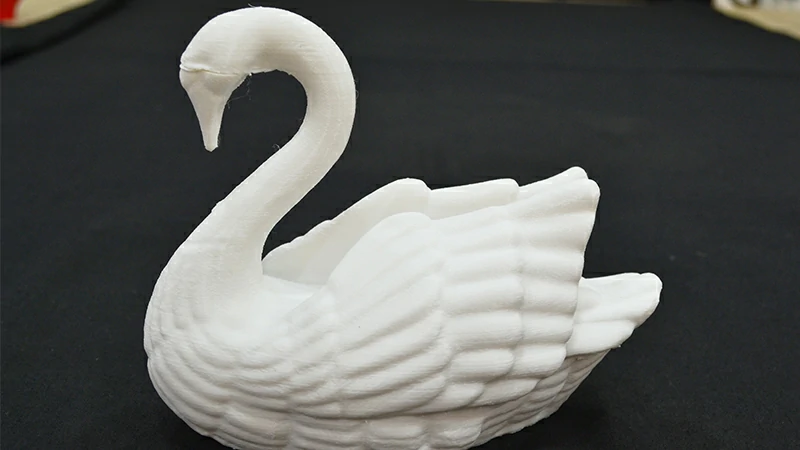
Aerospace 3D printing is the use of additive manufacturing technologies to produce prototypes, tooling, components, and selected production parts for aircraft, spacecraft, drones, satellites, and other aerospace systems.
Unlike traditional machining, which removes material from a larger block, additive manufacturing builds a part layer by layer from a digital 3D model.
Depending on the application, aerospace manufacturers may use technologies such as:
Selective Laser Sintering (SLS)
Selective Laser Melting (SLM)
Direct Metal Laser Sintering (DMLS)
Fused Deposition Modeling (FDM)
Stereolithography (SLA)
Multi Jet Fusion (MJF)
Other metal and polymer additive manufacturing processes
The choice of technology depends on the required material, accuracy, mechanical performance, production volume, and application.
Why Is 3D Printing Important for the Aerospace Industry?
Aerospace engineering places strict demands on weight, strength, reliability, geometry, and manufacturing consistency. Additive manufacturing provides several capabilities that can complement conventional aerospace manufacturing.
1. Lightweight Aerospace Components
Reducing aircraft weight can improve fuel efficiency and payload efficiency. Additive manufacturing allows engineers to design internal structures that would be difficult or impossible to manufacture using conventional methods.
Examples include:
Lattice structures
Topology-optimized brackets
Lightweight housings
Internal support structures
Complex structural components
Instead of designing a solid component and removing material afterward, engineers can design the internal structure specifically for the required load conditions.
2. Complex Geometries
One of the major advantages of additive manufacturing is its ability to produce complex geometries.
Traditional machining can become difficult when a component contains:
Internal channels
Complex cavities
Curved surfaces
Thin walls
Organic geometries
Integrated structures
Lightweight lattice patterns
3D printing can manufacture many of these geometries directly from a digital model, although support structures and post-processing may still be required depending on the technology.
How Is 3D Printing Used in Aerospace?
Aerospace companies use additive manufacturing across different stages of product development.
Aerospace Rapid Prototyping
3D printing is widely used to produce prototypes before committing to expensive tooling or production processes.
Engineers can create physical prototypes to evaluate:
Form
Fit
Assembly
Ergonomics
Aerodynamic concepts
Internal clearances
Installation procedures
Design changes
This allows design teams to identify potential problems earlier in the development process.
Aerospace Tooling and Fixtures
Additive manufacturing can also produce customized:
Assembly fixtures
Inspection fixtures
Manufacturing aids
Drill guides
Jigs
Tooling components
Protective covers
Because these tools can be produced directly from digital models, manufacturers can quickly create customized tooling for specific aerospace programs.
Aircraft Components
Depending on the material, manufacturing process, design requirements, and qualification status, additive manufacturing can be considered for components such as:
Brackets
Ducts
Housings
Mounting components
Covers
Airflow components
Structural prototypes
Interior components
Not every aerospace component is suitable for 3D printing. Critical flight hardware requires appropriate engineering validation, material controls, process qualification, inspection, and regulatory compliance.
Metal 3D Printing for Aerospace
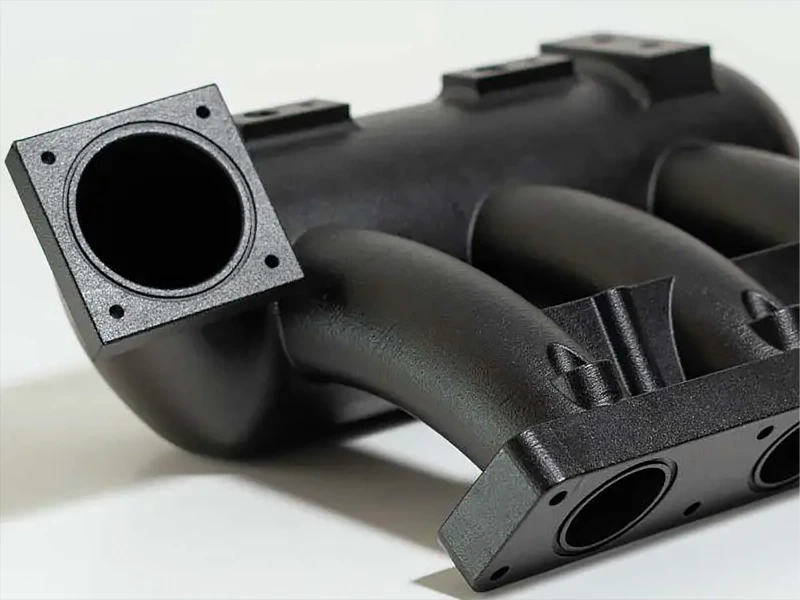
Metal additive manufacturing is particularly valuable for aerospace applications where lightweight structures, complex geometry, and high-performance materials are required.
Common aerospace metal 3D printing materials can include:
Aluminum
Aluminum alloys offer a combination of low density, strength, and machinability. They can be useful for lightweight aerospace components and prototypes.
Titanium
Titanium alloys provide high strength-to-weight performance and corrosion resistance. They are commonly considered for demanding aerospace applications where weight and mechanical performance are important.
Stainless Steel
Stainless steel can provide strength, corrosion resistance, and durability for suitable aerospace components and tooling applications.
Nickel-Based Alloys
Nickel-based alloys can withstand high temperatures and demanding environments, making them relevant to certain aerospace and propulsion applications.
Material selection should always be based on the specific engineering requirements and applicable aerospace standards.
3D Printing vs CNC Machining for Aerospace Parts
Both additive manufacturing and CNC machining are important aerospace manufacturing technologies.
Factor | 3D Printing | CNC Machining |
|---|---|---|
Manufacturing method | Adds material layer by layer | Removes material |
Complex geometry | Excellent for many complex designs | Excellent, but geometry can affect machinability |
Material waste | Generally lower | Can be higher depending on part geometry |
Internal channels | Can be highly suitable | Often more difficult to machine |
Lightweight structures | Excellent potential | Possible but may require extensive machining |
Surface finish | Often requires post-processing | Generally very good |
Dimensional accuracy | Depends on technology and material | Generally very high |
Prototype development | Fast for many geometries | Fast for many functional metal parts |
Production volume | Application dependent | Suitable for prototypes and production |
Tooling | Usually minimal | Usually minimal, but fixtures may be required |
The two technologies do not necessarily compete with each other. Aerospace manufacturers can use 3D printing for complex or lightweight structures and CNC machining for precision features and finishing operations.
Can Aerospace 3D Printed Parts Be CNC Machined After Printing?
Yes. Hybrid manufacturing is often used when an aerospace component requires both additive manufacturing and high-precision machined surfaces.
For example, a metal component can first be produced using additive manufacturing and then CNC machined to achieve tighter tolerances on:
Mounting holes
Threads
Sealing surfaces
Bearing seats
Precision interfaces
Critical dimensional features
This approach can combine the geometric freedom of additive manufacturing with the dimensional accuracy and surface finish achievable through CNC machining.
What Are the Main Benefits of Aerospace Additive Manufacturing?
The major benefits can be summarized as follows:
Design Freedom
Additive manufacturing allows engineers to explore geometries that may be difficult to produce using conventional machining or fabrication.
Weight Reduction
Topology optimization and lattice structures can reduce unnecessary material while maintaining the required structural performance when properly engineered and validated.
Faster Prototyping
Digital designs can be converted into physical prototypes without creating traditional molds or extensive tooling.
Reduced Material Waste
Because additive manufacturing builds material only where needed, it can reduce waste compared with manufacturing a complex component from a large material block.
Design Iteration
Engineers can modify a CAD model and produce another prototype without completely redesigning traditional tooling.
Part Consolidation
Multiple components may sometimes be redesigned as a single printed component. This can reduce assembly operations and potentially reduce the number of interfaces.
What Are the Challenges of 3D Printing for Aerospace?
3D printing does not automatically replace conventional aerospace manufacturing. Several technical challenges need to be considered.
Material Properties
Printed materials can have properties influenced by build orientation, process parameters, thermal history, and post-processing.
Surface Finish
Some additive manufacturing processes produce surfaces that require machining, polishing, blasting, or other finishing operations.
Dimensional Accuracy
The achievable tolerance depends on the additive manufacturing technology, material, part geometry, build orientation, and post-processing.
Internal Defects
Metal additive manufacturing requires appropriate process control and inspection to identify potential defects or inconsistencies.
Qualification and Certification
Aerospace components may be subject to strict qualification, traceability, testing, inspection, and regulatory requirements.
Therefore, selecting an aerospace 3D printing supplier requires more than simply comparing printing prices.
What Should You Consider When Choosing an Aerospace 3D Printing Process?
A practical manufacturing decision should consider several factors.
Requirement | Key Question |
|---|---|
Material | What material properties are required? |
Geometry | Does the part contain complex or internal features? |
Tolerance | What dimensional accuracy is required? |
Surface finish | Does the component require post-processing? |
Strength | What mechanical loads will the part experience? |
Temperature | Will the part operate in a high-temperature environment? |
Production volume | Is it a prototype, low-volume batch, or production part? |
Certification | What qualification or regulatory requirements apply? |
Lead time | How quickly are parts required? |
Cost | What is the total manufacturing cost after post-processing and inspection? |
This framework helps engineers determine whether 3D printing, CNC machining, injection molding, sheet metal fabrication, or a combination of processes is appropriate.
How Does 3D Printing Support Aerospace Rapid Prototyping?
Aerospace product development often involves multiple design iterations.
A typical workflow can be:
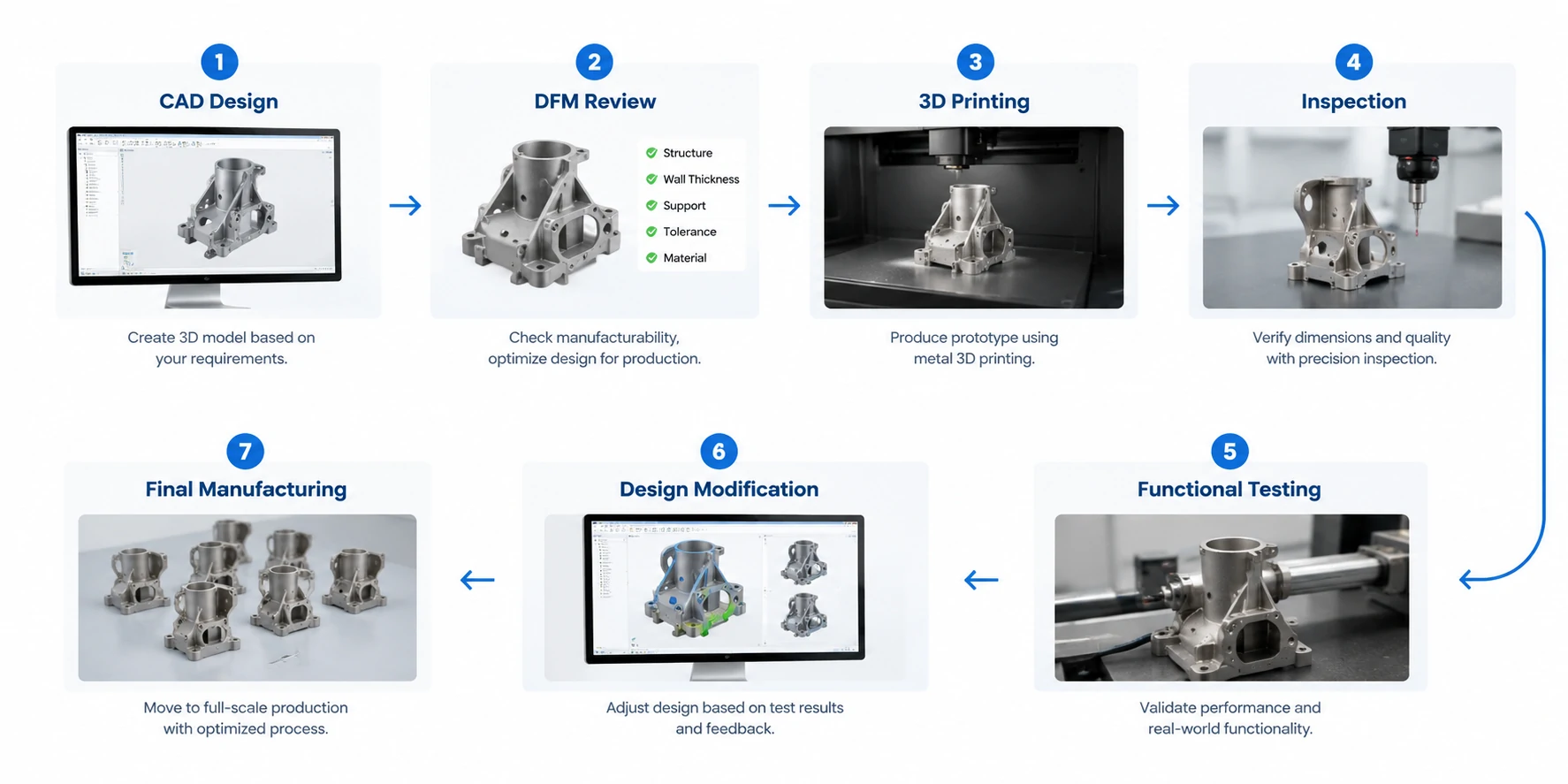
CAD Design → DFM Review → 3D Printing → Inspection → Functional Testing → Design Modification → Final Manufacturing
For example, an engineering team may need to test the installation of a new aircraft component.
Instead of immediately producing the final part using an expensive production process, engineers can first create a prototype using 3D printing.
The prototype can then be evaluated for:
Fit
Assembly
Clearance
Shape
Weight
Function
Interference
Installation procedure
After testing, the digital design can be modified and another prototype produced.
This iterative approach can reduce development risk before production tooling or final manufacturing begins.
What Aerospace Parts Are Suitable for 3D Printing?
The suitability of a component depends on its engineering requirements, but common candidates can include:
Aerospace prototypes
Lightweight brackets
Air ducts
Housings
Mounting components
Fixtures
Jigs
Tooling
Covers
Complex internal-channel components
UAV components
Satellite prototypes
Engine-related development components
For safety-critical flight hardware, the manufacturing process must meet the applicable engineering, quality, inspection, qualification, and regulatory requirements.
3D Printing for UAV and Drone Manufacturing
Unmanned aerial vehicles and drones are another area where additive manufacturing can be useful.
Drone designers often prioritize:
Low weight
Complex aerodynamic shapes
Rapid design iteration
Customized components
Low-volume production
3D printing can help engineers quickly test different:
Airframe components
Mounting brackets
Sensor housings
Propulsion-related components
Camera mounts
Protective housings
Internal structures
Because drone designs can change frequently, additive manufacturing can be particularly useful during development and prototype stages.
How Does Aerospace 3D Printing Reduce Development Time?
The main time-saving advantage is the ability to move directly from a digital design to a physical prototype without requiring conventional tooling for many applications.
A simplified development cycle is:
Digital Design → Prototype → Test → Modify → Reprint
This can make design iteration more flexible.
However, total lead time should include:
CAD preparation
Design review
Build preparation
Printing
Support removal
Heat treatment
CNC machining
Surface finishing
Inspection
Testing
Therefore, the fastest printing process is not always the process with the shortest total manufacturing lead time.
How to Choose an Aerospace 3D Printing Manufacturer
When evaluating an aerospace 3D printing supplier, consider more than the machine type.
Important questions include:
1. What Additive Manufacturing Technologies Are Available?
Check whether the supplier offers the specific process required for your material and geometry.
2. What Materials Can They Process?
Confirm the exact alloy or polymer, material specifications, and available documentation.
3. Can They Provide Post-Processing?
Ask about:
Heat treatment
CNC machining
Surface finishing
Support removal
Inspection
Dimensional verification
4. How Is Quality Controlled?
For aerospace applications, quality control may include dimensional inspection, material documentation, process records, and other testing depending on the application.
5. Can They Support DFM?
An experienced manufacturer can review the CAD model and identify potential problems involving:
Wall thickness
Support structures
Build orientation
Tolerances
Machining allowances
Assembly interfaces
3D Printing and the Future of Aerospace Manufacturing
Additive manufacturing is unlikely to replace every conventional aerospace manufacturing method. Instead, the industry is moving toward a combination of technologies.
A future aerospace production workflow may combine:
3D Printing + CNC Machining + Traditional Manufacturing + Advanced Inspection
3D printing can produce complex near-net-shape components, while CNC machining can provide high-precision interfaces and traditional manufacturing methods can remain suitable for parts where they offer technical or economic advantages.
The result is a more flexible manufacturing ecosystem rather than a single replacement technology.
Frequently Asked Questions About Aerospace 3D Printing
What is 3D printing used for in aerospace?
3D printing is used for aerospace prototypes, tooling, fixtures, lightweight components, complex geometries, UAV components, and selected production parts. Its suitability depends on material, design, performance, qualification, and regulatory requirements.
What is the best 3D printing technology for aerospace?
There is no single best technology for every aerospace application. Metal processes such as laser powder bed fusion may be appropriate for certain high-performance metal components, while polymer processes can be suitable for prototypes, tooling, fixtures, and selected non-critical components.
Is metal 3D printing suitable for aerospace parts?
Metal additive manufacturing can be suitable for aerospace components that require complex geometry, high strength-to-weight performance, or specialized materials. The appropriate process depends on the material, design, performance requirements, inspection requirements, and qualification status.
Is 3D printing cheaper than CNC machining for aerospace parts?
Not always. 3D printing can be economically attractive for complex geometries, lightweight structures, and low-volume production, while CNC machining may be more cost-effective for parts with simpler geometries, tight tolerances, or favorable machining characteristics.
Can 3D printed aerospace parts be used as final production parts?
Yes, additive manufacturing can be used for selected end-use aerospace components. However, flight-critical applications may require extensive qualification, process validation, inspection, traceability, and regulatory approval.
Why is 3D printing useful for aerospace prototyping?
3D printing allows engineers to produce physical prototypes directly from digital designs with relatively little tooling. This makes it easier to test designs, identify problems, and iterate before moving to final production.
Conclusion
3D printing is becoming an important part of modern aerospace manufacturing because it enables complex geometries, lightweight designs, rapid prototyping, and digital manufacturing workflows.
However, aerospace manufacturing requires more than simply producing a part. Material selection, dimensional accuracy, mechanical performance, surface finish, post-processing, inspection, traceability, and qualification all need to be considered.
For many aerospace development projects, the most effective approach is not choosing between additive manufacturing and conventional manufacturing. Instead, engineers can combine 3D printing, CNC machining, and other manufacturing processes according to the specific requirements of each component.
QY Prototypes provides custom manufacturing services including3D printing, CNC machining, and injection molding, supporting prototype development and low-volume custom part production for international customers.